
What’s actually changing from 1 October?

There is a significant NDIS change coming from 1 October that I think OTs need to understand.
It is called a support determination.
From 1 October 2026, support determinations will begin affecting funding in certain NDIS support budgets when a participant’s plan is reassessed or a new plan is approved. For OTs working in capacity building, community participation and with participants who have high support needs, there are some significant practical implications.
What is a support determination?
The new NDIS legislation gives the Minister the power to make a support determination that reduces funding for particular types of supports in old framework plans.
The government has confirmed that it intends to use this power to reduce budget allocations for two areas:
-
assistance with social, economic and community participation by 50%
-
improved daily living skills by 10%
For many OTs, that second category will immediately stand out. Improved daily living is where much of our capacity building Occupational Therapy funding currently sits. A 10% reduction may not sound as dramatic as 50%, but it still has implications for how much therapy and capacity building support participants may be able to access. The 50% reduction to social and community participation is even more significant.
It won’t happen to everyone on 1 October
This is an important distinction. The changes begin from 1 October 2026 when a participant’s plan is reassessed or a new plan is approved. They will not simply cut every existing participant’s budget on that date. From 1 February 2027, the reductions will also begin applying as plans are renewed.
So we are going to see this introduced progressively rather than waking up on 1 October to every participant having a different budget. That means OTs may start seeing participants with very different funding arrangements depending on where they are in their planning cycle.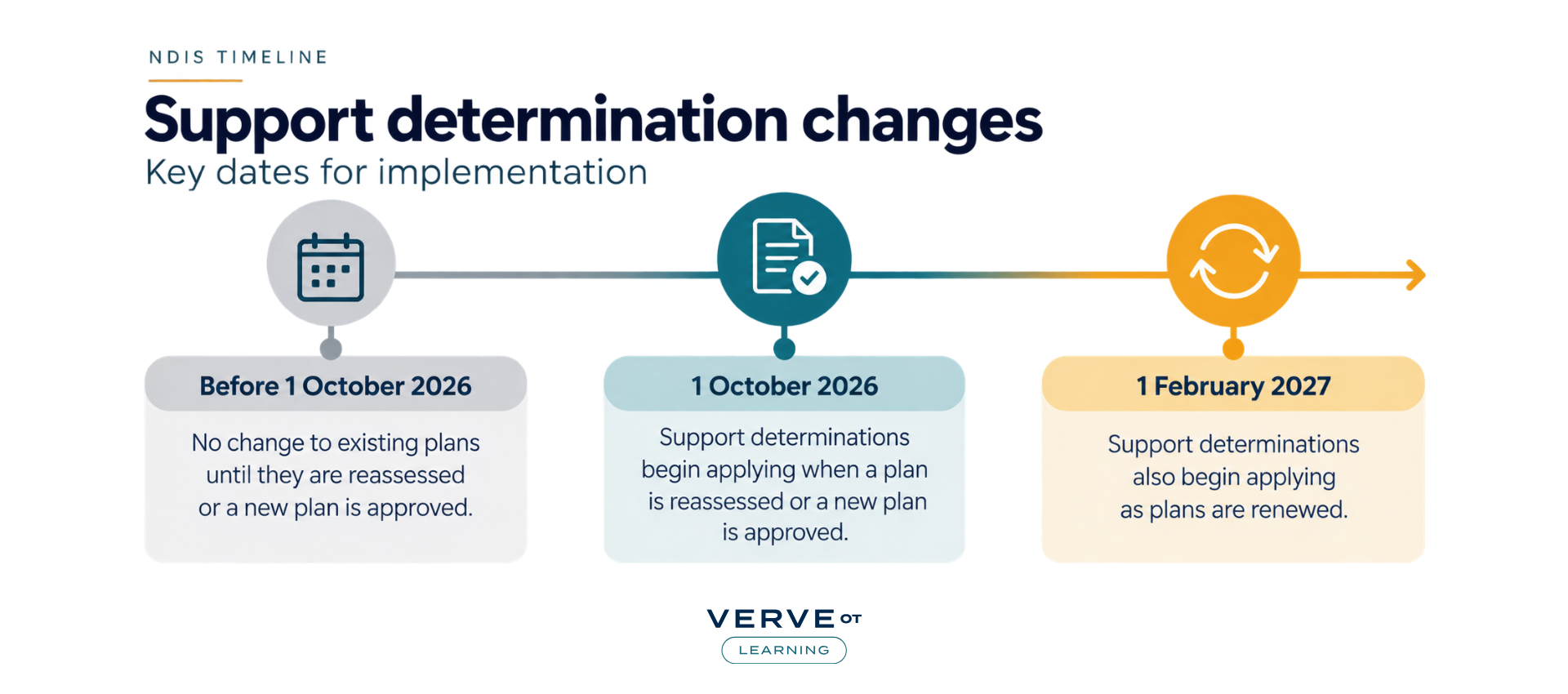
What about participants with high support needs?
This is one of the areas I am particularly interested in. If somebody currently receives significant community participation funding because they require continuous support, what happens when that funding category is reduced by 50%?
The government has recognised this issue for participants with high support needs who require 24-hour disability support. A new plan variation pathway will allow eligible participants to apply for a variation within 90 days of a support determination applying to them.
Importantly, this is not necessarily additional funding on top of what they previously received. The intent is that, where the reduction in community participation funding leaves a participant without sufficient support to remain safe at home, funding can be backfilled through their daily living supports so their essential 24-hour support needs can continue to be met.
We know that pathway is coming. What we don’t yet have is the operational detail about exactly how eligibility will be determined, what evidence will be required, how the amount will be calculated, or how the process will work in practice. The NDIA says further information will be released.
For OTs completing functional assessments and supporting participants with complex needs, these are important questions. We need to know what evidence is required for inclusion in our FCA reports. And we need to know it before the 1st October.
What about everyone else?
Unfortunately, a reduction in funding resulting from a support determination is not itself a reviewable decision. This means that, for many participants affected by these reductions, there will be no direct pathway to challenge the support determination or have the reduced funding restored through a review.
The key question then becomes: what happens when the funding available under the support determination no longer reflects the participant’s actual disability-related support needs?
Our evidence is going to matter
If a participant requires significant support across a 24-hour period, we need to be very clear about what that actually looks like.
- What assistance do they require?
- When do they require it?
- What happens without that support?
- What are the functional consequences and risks?
- And importantly, which supports are required because of the person’s disability?
This is already what good functional assessment should do. But when there are mechanisms that can substantially reduce particular support budgets, the quality and specificity of our evidence becomes even more important.
I don’t think the answer is simply to recommend more hours. Our job is to demonstrate why the support is required. That means clearly connecting functional impairment, real-world evidence, risk, clinical reasoning and the level of support being recommended.
1 October is the beginning, not the end
We now know considerably more about what is intended. We know which two support budgets the government intends to reduce. We know the size of those reductions. We know when they start being applied. And we know there is a pathway intended to protect critical supports for participants with high support needs.
What we don’t yet know is exactly what this will look like when individual participants start moving through the process. That is the part I’ll be watching most closely after 1 October.
Because for OTs, the important question isn’t simply whether funding has changed. It is what happens to the person who needs that support when it does.
Want more practical OT updates?
Subscribe to the Verve OT Learning newsletter and have the latest delivered straight to your inbox each Monday.
