
Review, reassessment or variation? What OTs need to know now
Sep 01, 2026
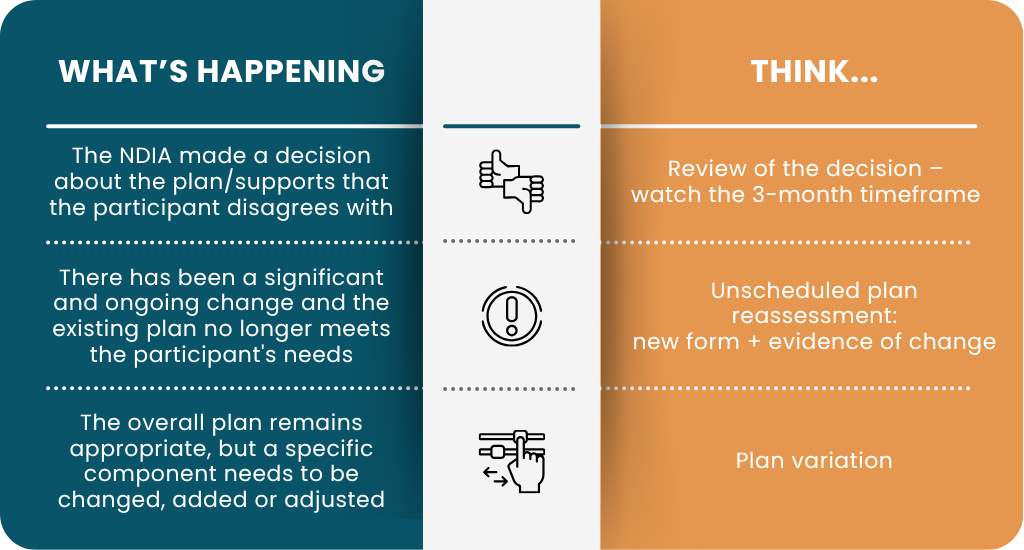
With the NDIS changes that commenced on 27 August 2026, it is more important than ever for OTs to understand the difference between a review of a decision, an unscheduled plan reassessment and a plan variation.
They are not interchangeable. They have different purposes, different thresholds and different evidence requirements and choosing the wrong pathway may have significant consequences for a participant.
Review of a decision – when the participant disagrees with what the NDIA decided
If a participant receives a new plan and believes the NDIA has not funded the supports they require, the appropriate pathway may be an internal review of the decision under section 100 of the NDIS Act — rather than waiting and later attempting to seek an unscheduled reassessment.
For example, the participant may believe:
- the funded support hours or ratios are insufficient;
- a recommended support has not been funded;
- the amount of funding provided is inadequate; or
- the NDIA has decided that a recommended support is not reasonable and necessary.
The decision to approve the participant's plan, including the NDIS supports funded within it, is a reviewable decision. Importantly, the participant generally has 3 months from receiving the decision in writing to request an internal review.
This timeframe matters even more under the new reassessment rules.
If the issue is simply that the NDIA made a decision the participant disagrees with, allowing the three-month review period to expire and subsequently trying to address the underfunding through an unscheduled plan reassessment may be problematic.
An unscheduled reassessment now has a different gateway: the evidence needs to demonstrate a significant and ongoing change to the participant's support needs.
So, for OTs:
If the new plan does not adequately fund the participant's existing needs, don't automatically wait for a change in circumstances. Make sure the participant understands the time limit for reviewing the original decision.
Unscheduled plan reassessment – something significant and ongoing has changed
An unscheduled plan reassessment is different. It is intended for circumstances where there has been a significant change and the participant's current plan no longer meets their needs.
The NDIA identifies ongoing changes such as changes to the person's ability to undertake daily activities or changes to their living arrangements, education, work or help from others.
From 27 August 2026, there is also a new Plan Reassessment Request Form. Only the participant, their plan nominee or child representative can request the reassessment; they cannot simply give a provider consent to make the request on their behalf.
The evidence accompanying the request needs to demonstrate the significant change to the participant's ongoing support needs. The NDIA says evidence will usually need to be within four months of the request and obtained after the current plan was approved.
This changes how we need to think about our FCA evidence...
Rather than simply demonstrating: “The participant needs more support.”
we need to clearly establish:
What has changed? → How significant is it? → Is it ongoing? → How has it changed the participant's support needs? → Why can the existing plan no longer adequately respond?
Plan variation – the plan is largely right, but part of it needs to change
A plan variation is different again. Rather than replacing the participant's plan through a full reassessment, a variation changes part of the existing plan.
The NDIA describes variations as appropriate for smaller changes and can also use them to add or correct information, provide urgent or short-term funding, or make certain changes to the participant's funded supports.
For OTs, this may be particularly relevant where the NDIA has already recognised a support need but additional information, assessment, prescription or quotes are required to determine or increase the specific funding.
For example:
Assistive Technology
A participant may already have an identified AT need, but following assessment and trials the final prescribed solution requires additional funding. The NDIA specifically gives the example of adding AT recommended in an OT report that it requested during planning as something that may be dealt with through a variation.
Home modifications
Funding may have been included to progress assessment/design, with the OT subsequently providing the required scope, clinical evidence, cost estimate or quotes. Complex home modifications, for example, generally require two itemised quotes or a cost estimate.
Vehicle modifications
Similarly, further assessment, prescription and quotation may establish the actual funding required for the recommended vehicle modification.
In these situations, the issue isn't necessarily that the participant has experienced a significant and ongoing change requiring their whole plan to be reassessed. The evidence may instead be completing the information the NDIA needs to make a change to a particular part of the existing plan.
Download the Plan Variation Request Form here.
The key distinction for OTs
Want more practical OT updates?
Subscribe to the Verve OT Learning newsletter and have the latest delivered straight to your inbox each Monday.
